


More than people tend to realize, hospital negligence occurs regularly. Under-staffed floors, hasty medical treatments, miscommunication among healthcare workers about a patient’s orders, incorrect medications given, the presence of preventable infections, inadequate diagnosis leading to delays in identifying problems, etc. All of these types of failures lead to real harm when you allow the hospital to become liable for your injuries.
We’ll provide an overview of hospital negligence according to Florida law, the type of evidence required, the process for filing a claim against a hospital, and the potential compensation you could receive. If you are currently going through this experience, do not expect to handle it without assistance. Zoeller Law Firm has been assisting injured patients and families throughout Florida for many years and is willing to discuss your particular situation at no cost.

Hurt or Lose a Loved one to Medical Malpractice? Let Us Help You
Hurt or Lose a Loved one to Medical Malpractice? Let Us Help You
Get your FREE & confidential case review today 561-689-8180
Hospital Negligence According to Florida Law
The definition of negligence is based upon the breach of duty owed by a person to another that resulted in damage. In the context of a hospital, that duty extends beyond just a doctor or surgeon to also include nurses, technicians, pharmacists, and even administrators whose actions or omissions contribute to a patient’s injury. Therefore, under Florida Statute § 766.102, a hospital must provide a level of care, skill, and treatment consistent with that accepted by similarly situated professionals in the same geographic location.
In Florida, Hospitals Are Also Responsible for Their Employees’ Actions
Many people misunderstand that hospitals can be held responsible for their employees’ negligence. The theory behind this is called respondeat superior, which literally translates from Latin into English as “the master shall answer”. If a registered nurse gives a patient the wrong medication during her shift, the hospital is not released from liability simply because she was the individual who made the error. Similarly, if an orderly or technician fails to properly move a patient safely prior to an operation, the hospital is liable.
Related Articles
6 Signs of Medical Malpractice You Shouldn’t Ignore
Independent Contractors are Different
Some hospitals attempt to reduce their exposure by claiming that their employees are independent contractors rather than actual employees. However, if the hospital has control over how and where the contractor performs his duties, then he is considered an employee of the hospital. What constitutes control varies depending on the case.
Examples of Common Types of Hospital Negligence
While hospital negligence comes in many different forms, examples include:
- Errors in communication between health care providers. These occur frequently, particularly during shift changes and/or when transferring patients from one facility to another.
- Diagnosis errors. These include failing to obtain diagnostic testing or misinterpreting test results.
- Medication errors. Examples include giving a patient the wrong medication or giving him/her too little or too much medication. Other types of medication errors include giving medication to a patient who has previously demonstrated an allergic reaction.
- Error regarding anesthesia administered prior to, during, and/or subsequent to a procedure.
- Surgical errors. Surgical errors include operating on the wrong side of the body or leaving objects inside a patient.
- Failing to monitor a patient postoperatively and/or during times when a patient is in a high-risk condition.
- Providing inadequate personnel, which ultimately results in delayed/missed care.
- Failures involving equipment. Failures can result from inadequate maintenance and/or misuse.
- Failure of negligent credentialing. Credentialing occurs when a hospital allows an unqualified or unsuitable practitioner to practice.
- Hospital-acquired infections arise from a lack of proper sanitation and/or compliance with standards of infection control.
For example, an abdominal surgery patient becomes febrile on day 2 of recovery. Nursing staff document this in the patient’s chart but fail to elevate this finding. On day 3, the patient developed sepsis. Had timely action been taken on day 1 to address this issue, perhaps the infection would not have spread so quickly. The failure to act was an exemplary demonstration of hospital negligence.
Evidence Required To Establish Hospital Negligence

Stronger cases depend upon stronger evidence. Collecting that evidence as early as possible will enhance your position in negotiations. The following represents what you will need:
Medical Records
The medical records represent your strongest source of evidence. Those records may include:
- The hospital chart.
- Nursing staff progress notes;
- Prescriptions ordered by your treating physician;
- Laboratory and radiology studies;
- Image study results;
- Discharges summaries; and,
- Incident report(s).
As stated above, you have the right under Florida law (Florida Statute § 395.3025) to access your own medical records. Hospitals are obligated to supply copies of your patient records upon receipt of your written request. You may be charged for the costs associated with making those copies; however, you are entitled to review your records regardless of whether the hospital wishes to cooperate.
Request Everything
Assume nothing about what evidence your hospital will willingly disclose. Once an attorney sends a preservation letter early in your case, the hospital is placed on formal notice that it must retain all relevant documents (including electronically stored documents and communications) and not dispose of or modify them.
Physical Evidence
When defective devices (e.g., faulty surgical instruments), contaminated medication (e.g., tainted antibiotic), or defective equipment (e.g., malfunctioning ventilator) contributed to your injury, save that item if feasible. Photographs of any damaged item should be taken immediately. Do not discard packaging materials, I.V. bags, or any items related to your care/treatment. Your attorney will also help secure physical evidence from your hospital through formal legal processes.
Witness Statements
Family members who were present during treatment and/or other patients who witnessed events related to your care/treatment may be valuable witnesses. Document what each witness saw as soon as possible. As memories begin to fade and details become less vivid, writing down observations while they remain clear will be invaluable in establishing liability.
Personal Diary/Journal
Begin documenting your symptoms, pain, impact on daily routine, things you can no longer do; activities you have missed; loss of sleep; emotional challenges you face, etc. Documentation of this nature provides substantial support for non-monetary damages (pain and suffering) and is far more credible when documented simultaneously as opposed to reconstructively thereafter.
Engage an Attorney Early
Early involvement of an attorney in this process is far more beneficial than most people understand. The sooner you engage an attorney, the greater likelihood that critical evidence will be preserved; necessary pre-suit requirements will be met; and pitfalls which may compromise your ability to bring a successful claim will be avoided. Additionally, waiting too long can result in losing evidence and closing the statutory time bar for filing your claim.
Florida State Statutes & Rules Impacting Medical Malpractice Claims Against Hospitals
Medical malpractice laws in Florida differ from typical personal injury claims in several respects. Failure to comply with these differences may result in dismissal of your claim prior to reaching a jury verdict.
Statute of Limitations
According to Florida Statute § 95.11(4)(b), generally speaking, you have two years from the occurrence date or date when you became aware (and/or should have become aware) of your injury to file a medical malpractice claim against a hospital. In addition to this statute of limitations time frame, Florida imposes a hard four-year maximum time period for filing medical malpractice claims, regardless of when you become aware of the injury.
However, there are certain exceptions that apply:
- If the provider engaged in fraudulent concealment relative to the negligence complained of by you, the statute of limitations may be extended by up to seven years.
- If you were a minor at the time of the injury complained of, the limitations period may be stayed (tolled) until you reach adulthood (18).
- If it was impossible for you to know of your injury (could not reasonably have known) at first glance, the two-year clock begins when you discovered or should have discovered your injury – not when the injury occurred.
Example: Patient undergoes abdominal surgery on January 15th, 2023. A surgical sponge is retained inside the patient’s abdomen and does not cause immediate symptoms, but creates severe infection by late 2024. The two-year clock is probably triggered by when the patient became aware of or reasonably should have become aware of his injury, not on the date of surgery.
Pre-Suit Obligations
Prior to bringing a medical malpractice claim against a hospital, Florida law (Florida Statute § 766.106) requires that you notify every defendant with whom you intend to pursue litigation that you plan to sue them using a document titled “Notice of Intent to Initiate Litigation.” This formally notifies both the hospital and any other parties that you plan to seek damages against them.
After service of the notice, a ninety (90) day investigative window opens. During this time frame, defendants will have the opportunity to investigate your complaint, request additional documentation/information regarding your claim, determine whether they wish to settle with you, admit liability, or choose not to resolve with you at all. Regardless of their decision, once the ninety (90) days have elapsed from service of the notice, you will be permitted to proceed with filing suit against the defendants, subject to certain exceptions.
Additionally, as part of meeting your obligations prior to commencing litigation, you will require an Affidavit of Merit executed by a qualified medical professional who reviews the facts and believes there exists a sufficient basis for believing that negligence occurred. Pursuant to Florida Statute § 766.102, the qualifications required for an expert witness vary depending upon the field in which he/she practices. Furthermore, courts view affidavits very seriously, and thus it is essential for you to select the correct expert for your particular medical discipline.
Sovereign immunity applies to publicly run hospitals – but how much can I get back?
As noted above, if the hospital in question is publicly run (i.e., owned or run by a local governmental agency, e.g., a state university hospital or county hospital), the “sovereign immunity” laws of Florida govern. Under these laws, you can still file a Lawsuit; however, the amount of money you can recover is limited. In general terms, Florida law sets maximum limits of $200,000 per plaintiff and/or $300,000 per occurrence for lawsuits filed against public agencies. These caps can be waived by the Florida Legislature via approval of a claims bill.
Identifying whether a hospital is owned by the state can be confusing
Some hospitals that appear to be well-known name-brand hospitals could actually be owned or controlled by governmental authorities. For example, a hospital affiliated with a national chain that is partially funded by tax dollars may qualify for protection under Florida’s sovereign immunity laws. Your lawyer should be able to quickly identify whether a hospital qualifies for sovereign immunity status, since this impacts the timing and scope of filing your Lawsuit.
The step-by-step process to file a hospital malpractice claim in Florida
In addition to being far more complicated than the average “slip-and-fall” type Lawsuit, a medical malpractice claim against a hospital involves many more detailed steps. Below is a truthful outline of what the process looks like from beginning to end.
Step 1: first meeting with your attorney
The first step is to meet with a competent medical malpractice attorney to see if your case merits further consideration. At Zoeller Law, our initial meetings are completely complimentary and held in confidence. We will go over what happened to you, review any documentation you have brought with you (e.g., medical records), and provide you with an honest assessment. If we believe you don’t have a good case, we’ll let you know.
Step 2: fact-gathering and document collection
After agreeing to represent you, we will immediately send out requests for your complete medical records. We issue “preservation notices” to the hospital to preserve any electronic data related to your visit. We also create a timeline of events. We then contact medical experts and obtain their opinions as to whether your caregivers’ actions met the standard of care. The collection of this information takes time. However, it is where strong claims are developed.
Step 3: Pre-Suit Investigation and Affidavit of Merit
Prior to serving the Notice of Intent on the hospital and/or other defendants, we must conduct a formal Pre-Suit Investigation and secure the necessary Affidavit of merit from a qualified medical Expert. That Expert must be certified in the area in which he/she testified that negligence existed and be willing to testify that negligence did exist. Identifying the proper Expert is rarely easy, and the quality of the Expert’s opinion can greatly affect the strength of your overall claim.
Step 4: service of notice of intent and the 90-Day window
We deliver the Notice of Intent to the hospital and any other named defendants. After delivery of the Notice of Intent, the 90-Day investigation window begins. During this window, the hospital/its insurance company reviews your claim. While some claims settle during this window, most do not. If the hospital denies your claim or offers insufficient compensation for your injuries, we move forward to the next phase of your claim.
Step 5: filing suit
We prepare and file your formal Complaint in the applicable circuit court in Florida. The Complaint will list all named defendants (including doctors and nurses working for the hospital and potentially staffing companies or equipment manufacturers). It outlines what happened, why the medical community failed to meet the standards of care applicable to your situation, and what damage resulted.
For hospitals owned/operated by governmental agencies, there are unique procedures you must follow, including special notice procedures and abbreviated timeframes within which you must act. Your attorney must know these differences prior to taking on your claim.
Step 6: dispute resolution through Discovery and settlement negotiations
The Discovery process allows both parties to formally exchange information. Included among other things are sworn statements taken prior to Trial (depositions), document requests, interrogatories (written questions), and written reports prepared by Expert witnesses. The length of time spent in this process can vary widely depending upon the complexity of your claim. Most disputes between hospital malpractice plaintiffs and defendants ultimately end up in mediation prior to Trial. Mediation is a structured settlement negotiation session where both parties present their position to a third-party neutral mediator. Many disputes are resolved at mediation. If mediation is unsuccessful, the case proceeds to Trial.
Step 7: Trial
If your dispute cannot be resolved through either mediation or settlement negotiations, it will likely proceed to Trial. Both parties present their respective evidence and arguments to a jury. Typically, jurors must weigh competing Expert testimony regarding whether the hospital/healthcare provider breached the standard of care owed to you and what monetary award would fairly compensate you for your harm. Jury trials can range anywhere from one day to multiple weeks.
Following your win at Trial, you have the opportunity to appeal your judgment. Appeals can add even more time to an already lengthy process.
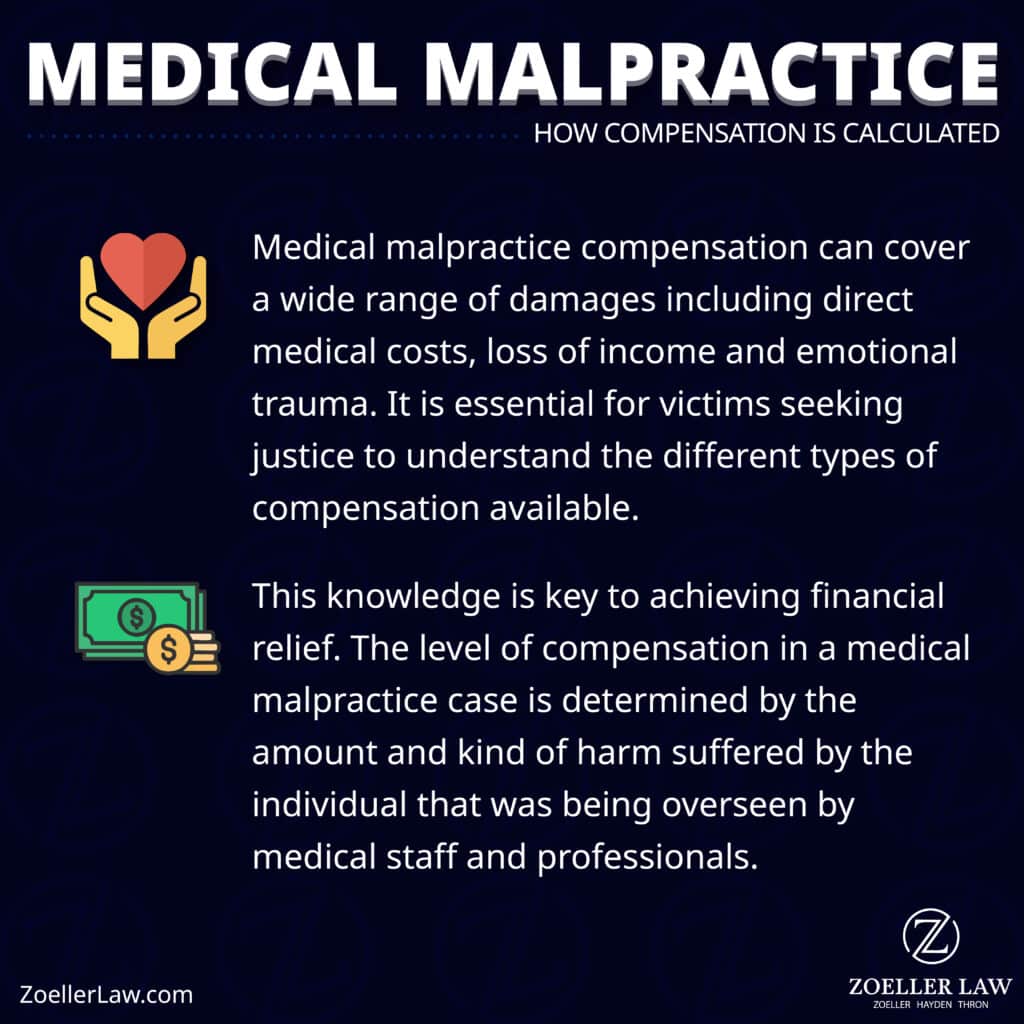
Types of compensation available to you
When successful in pursuing a claim based on hospital malpractice, you may be entitled to various types of compensation.
Monetary losses (economic damages)
These include monetary losses suffered due to the malpractice:
- Past medical expenses associated with your original hospital stay and subsequent treatment;
- Future medical expenses for continuing treatment or surgery;
- Lost income/wages earned during recovery; and,
- Reduced earning capacity resulting from permanent disability limits your employment opportunities.
Emotional suffering/pain & suffering (non-economic damages)
Non-economic damages refer to intangible harms that may arise from your experience but lack an easily quantifiable cost; i.e., pain and suffering, loss of enjoyment of life, loss of society/companionship (for spouses/partners/family members), etc. Prior to July 2017, Florida had a statutory cap on noneconomic damages for malpractice cases arising from privately-owned hospitals. However, in North Broward Hospital District v. Kalitan (decided by Florida’s supreme court in July 2017), that cap was declared unconstitutional. Therefore, when seeking non-economic damages for a private hospital malpractice case, Florida law now permits you to fully seek damages for all non-monetary harm you experienced.
Punitive damages
Only under exceptional circumstances, specifically when a defendant engaged in egregious behavior, are punitive damages allowed in malpractice cases. Punitive damages are permitted in Florida up to three times the economic damages awarded or up to $500,000.00, whichever number is greater.
Documenting your harm/damage claims
Save every document:
- All medical bills/paying invoices/receipts;
- Pay stubs illustrating lost wages/income;
- Receipts for out-of-pocket expenses (medications, travel expenses incurred while visiting doctors’ offices/hospitals/home care);
- Journal entries detailing pain/discomfort/emotional effects.
Oftentimes, an economist and/or a life care planner will need to estimate long-term costs associated with severe injuries, particularly when chronic medical care or diminished earning capacity is anticipated. Your attorney will hire those experts as needed in connection with your case.
Other channels for reporting/making claims against healthcare providers
While filing a Lawsuit is typically an available remedy for victims injured due to medical malpractice, it is not always the first course of action, nor is it always available. There are alternative avenues for reporting/making claims against healthcare providers.
Reporting problems with healthcare providers using state agencies
You can report problems with healthcare providers using:
- Florida’s Agency for Health Care Administration (AHCA), which licenses and monitors hospitals within Florida and investigates patient safety/quality concerns raised by consumers;
- Florida’s Department of Health (DOH), which oversees individual healthcare providers, and
- The United States Center for Medicare/medicaid services (CMS) requires that the healthcare provider receive federal funding under Medicare/Medicaid.
While filing complaints with these agencies does not lead directly to receiving compensation for past harm/damages sustained due to healthcare provider malfeasance, complaints filed may prompt investigations leading to corrective measures taken by the healthcare provider(s)/provider(s).
Patient bill of rights
Florida provides patients’ rights similar to those provided by most states under Florida statutes section 381.026:
- right to access your medical record(s);
- right to provide or withhold informed consent before undergoing medical treatment;
- right to receive medical services free from prejudice/discrimination;
- right to receive respectful/dignified treatment;
- right to receive an accurate description/explanation regarding diagnoses/treatment options.
Resources supporting patients who have been harmed
Being physically injured by the healthcare system, particularly when you were in a fragile state, can cause significant psychological damage. Patient advocacy organizations, mental health counselors, and support groups created for patients who have been impacted by medical errors are available throughout Florida. If you feel emotionally overwhelmed, please seek assistance from someone trained professionally. Additionally, your attorney can assist you in contacting patient advocates familiar with navigating the system.
Trial vs. Settlement: What is best?
Most medical malpractice cases settle prior to going to trial. Settlement provides quicker resolution to a case, increased anonymity, and lower stress. Trial, while providing potential for higher compensation, involves longer timelines, increased expenses, and uncertainty.
Ultimately, whether to try or settle will depend upon the strength of one’s evidence, the reasonableness of the settlement offered, and the specific needs and preferences of each client.
At Zoeller Law, we prepare all of our medical malpractice cases as if they are headed into trial. The preparation we perform for each of our clients often contributes to a reasonable settlement being extended by the defendant/hospital/insurer. Defendant/hospital/insurers recognize that we would proceed with litigation if they choose not to extend a reasonable settlement.
Defenses used by defendants/hospitals
The defense teams representing hospitals and/or their insurance companies have extensive experience in defending such claims. Each of these defense teams will employ numerous strategies in an attempt to defend their client. Some common strategies include:
- Contributory negligence: claiming that the plaintiff’s own actions resulted in his/her injuries because he/she failed to comply with medical providers’ instructions or did not provide accurate information regarding relevant medical conditions.
- Informed consent defense: arguing that the plaintiff was informed of all possible risks associated with treatment and chose to undergo treatment despite knowing of said risks.
- Independent contractor defense: stating that the medical professional involved in the alleged misconduct was an independent contractor of the hospital at issue.
- Causation defense: claiming that the plaintiff’s injuries were not caused by the hospital’s actions, but rather by the plaintiff’s pre-existing medical condition or an unforeseen complication.
Each of these defenses does not automatically defeat a claim. Rather, each represents an argument made by defendants that can be successfully refuted through the use of appropriate evidence and expert testimony. A seasoned attorney understands how each defense strategy is employed and how to refute each.
How often do plaintiffs win medical malpractice cases?
Statistics indicate that defendants prevail in approximately seventy-five percent (75%) of medical malpractice trials. While this data indicates that it is extremely difficult to prevail in such claims, it does not necessarily mean that valid claims should not be pursued. Valid claims require solid evidence, appropriate expert opinions, and skilled attorneys who have represented numerous clients in similar situations. Attorneys represent their clients throughout all phases of litigation. Therefore, quality representation during both preparation and presentation of evidence is critical in achieving favorable results.