


When someone causes a collision because they were too tired to drive safely, the victims deserve to know their rights. Understanding how fatigue affects a driver’s ability to operate a vehicle and how to prove that exhaustion played a role in a crash can make the difference in securing fair compensation.
How Fatigue Alters Brain Function While Driving
Sleep deprivation affects the brain in ways that directly compromise driving ability. After being awake for 18 hours straight, a person’s cognitive function resembles that of someone with a blood alcohol concentration of 0.05 percent. Stay awake for 24 hours, and the impairment level climbs to the equivalent of 0.10 percent, well above Florida’s legal limit of 0.08 percent for intoxication.
The prefrontal cortex, which handles decision-making and impulse control, loses efficiency when the body needs rest. Visual processing slows down. The ability to track multiple objects simultaneously declines. A fatigued driver may look at the road but not truly process what’s happening around them.
These changes happen gradually, which makes them deceptive. A driver might feel alert enough to continue but lack the mental capacity to respond when a child runs into the street or when traffic suddenly stops on I-95.

Looking for a Peaceful Legal Resolution? Let Us Help You
Looking for a Peaceful Legal Resolution? Let Us Help You
Get your FREE & confidential case review today 561-689-8180
Slower Reaction Times and Missed Hazards
Tired drivers take longer to notice danger and longer still to act on it. Research shows that reaction time can slow by up to 50 percent in sleep-deprived individuals. In a vehicle traveling at 60 miles per hour, every fraction of a second counts. A delayed response can mean the difference between stopping in time and plowing into the car ahead.
Fatigue also narrows a driver’s field of attention. Instead of scanning the full environment, a drowsy person tends to focus on a limited area directly in front of them. Peripheral hazards go unnoticed. A motorcycle approaching from the side, a pedestrian stepping off a curb, or a car merging from an adjacent lane may not register until it’s too late.
Even when a tired driver sees a hazard, their ability to execute an appropriate response suffers. Braking may be delayed. Steering adjustments might be imprecise. The smooth coordination required to avoid a collision breaks down under the weight of exhaustion.
Related Reading:
How to Preserve Vehicle Event Data and Chain of Custody After a Florida Crash
Pre-Existing Conditions & Car Accident Claims in Florida: Know Your Rights
Judgment Errors Caused by Sleep Deprivation
Fatigue doesn’t just slow a driver down. It alters their decision-making process in dangerous ways. A person who hasn’t slept enough is more likely to take risks they would normally avoid, such as speeding, following too closely, or attempting to pass in unsafe conditions.
The brain’s ability to assess risk deteriorates with tiredness. What should seem like an obviously bad idea, like trying to make it through a yellow light that’s about to turn red, suddenly feels reasonable. Overconfidence sets in. The driver believes they can handle situations that exceed their diminished capacity.
Sleep deprivation also reduces a person’s ability to maintain consistent speed and lane position. A fatigued driver may drift across lane lines, wander onto the shoulder, or fail to maintain a safe following distance. These lapses create unpredictability on the road, forcing other drivers to compensate for erratic behavior.
Microsleeps and Complete Loss of Awareness
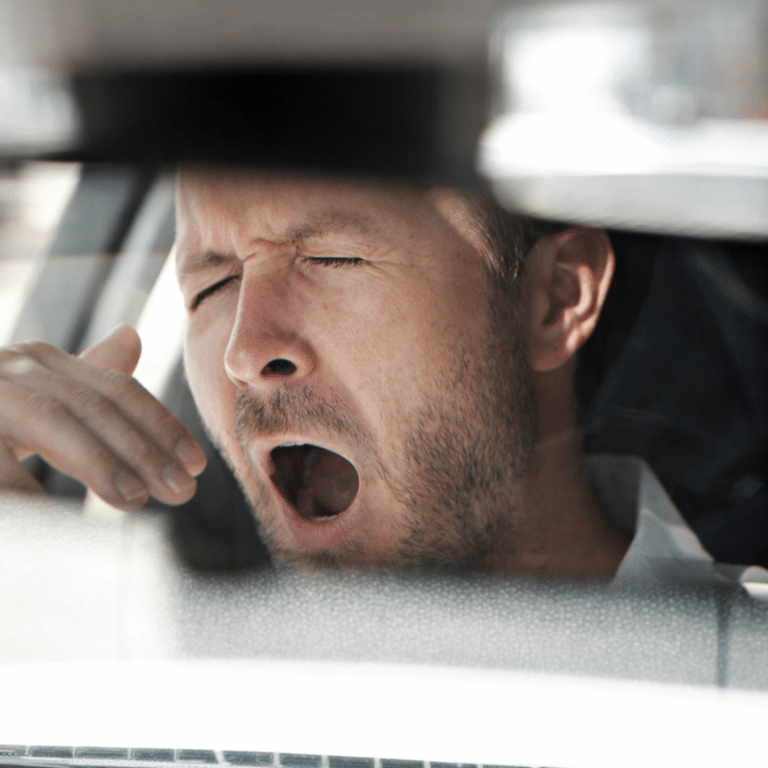 One of the most dangerous aspects of drowsy driving is the phenomenon of microsleeps. These are brief episodes, lasting anywhere from a fraction of a second to several seconds, during which the brain essentially shuts down. The person’s eyes may remain open, but they are effectively unconscious.
A microsleep lasting just three seconds at 60 miles per hour means the vehicle travels 264 feet with no one in control. That’s nearly the length of a football field. During that time, the car can veer off the road, cross the center line, or slam into another vehicle.
Drivers who experience microsleeps often don’t realize what happened. They might feel a momentary lapse, or they might have no memory of the event at all. By the time awareness returns, the crash has already occurred.
In more extreme cases, a driver falls asleep completely. These incidents often result in high-speed collisions with minimal or no braking before impact. The absence of skid marks can actually serve as evidence that the driver was asleep at the wheel.
Common Situations Where Drowsy Driving Occurs
Certain circumstances create a higher risk for fatigue-related crashes. Long-distance trips, particularly those that stretch into the late evening or overnight hours, test a driver’s ability to stay alert. The monotony of highway driving on routes like the Florida Turnpike or Alligator Alley can lull even a well-rested person into a dangerous state of drowsiness.
Shift workers face heightened risk as well. Those who work overnight or rotating schedules often drive home during hours when their body desperately wants to sleep. A nurse finishing a 12-hour night shift at a West Palm Beach hospital or a warehouse worker leaving at dawn fights against biology to make it home safely.
Commercial truck drivers, despite federal regulations designed to prevent fatigue, still cause crashes due to sleep deprivation. The Federal Motor Carrier Safety Administration limits the number of hours a commercial driver can operate a vehicle without rest. In Florida, violations of these hours-of-service rules can serve as evidence of negligence when a truck driver causes a collision.
Young drivers, particularly those between 16 and 25, are disproportionately involved in drowsy driving crashes. Irregular sleep schedules, late-night activities, and a tendency to underestimate the risks all contribute to this pattern.
Anyone who takes certain medications, particularly those that cause drowsiness as a side effect, needs to exercise caution. Cold medicines, allergy medications, muscle relaxants, and other prescriptions can amplify fatigue and make driving dangerous.
Looking for a Peaceful Legal Resolution? Let Us Help You
Looking for a Peaceful Legal Resolution? Let Us Help You
Get your FREE & confidential case review todayProving Fatigue in Accident Claims and Obtaining Compensation
When a drowsy driver causes a crash, proving that fatigue played a role requires careful investigation. Unlike alcohol impairment, which can be measured with a breathalyzer, exhaustion leaves no chemical trace. However, evidence can still establish that a driver was too tired to operate a vehicle safely.
Cell phone records may show that the driver was texting or talking late into the night before the crash. Work schedules can demonstrate that someone was operating on minimal sleep after a long shift. Witness statements might reveal that the driver appeared tired, had difficulty staying awake, or admitted to feeling drowsy before the collision.
The nature of the crash itself often provides clues. Single-vehicle accidents where the car drifts off the road or crosses the center line without any attempt to brake suggest a loss of consciousness. The absence of defensive maneuvers before impact points to a driver who wasn’t aware of the danger.
In commercial vehicle cases, logbooks and electronic logging devices track hours of service. Discrepancies between these records or violations of federal regulations can demonstrate that a truck driver was operating while fatigued.
Florida law allows victims of drowsy driving crashes to seek compensation for medical expenses, lost wages, pain and suffering, and other damages. When fatigue rises to the level of reckless behavior, such as when a driver knowingly gets behind the wheel despite being dangerously tired, punitive damages may be available.
Insurance companies often try to minimize or deny the role of fatigue in a crash. They may argue that other factors caused the collision or that there’s insufficient evidence to prove the driver was tired. An experienced attorney can counter these arguments by gathering comprehensive evidence and consulting with experts who specialize in sleep science and accident reconstruction.
Taking Action After a Drowsy Driving Crash
If you were injured in a crash caused by a fatigued driver, time matters. Evidence can disappear, memories fade, and insurance companies move quickly to minimize their exposure. Documenting the scene, obtaining medical treatment, and consulting with an attorney who handles these cases gives you the best chance of a full recovery.
The reality is that drowsy driving crashes are preventable. When someone makes the choice to drive while exhausted, they put everyone on the road at risk. Holding them accountable not only provides compensation for those they’ve harmed but sends a message about the seriousness of this behavior.
Understanding your rights and the legal options available after a drowsy driving accident in Florida can feel overwhelming, especially while dealing with injuries and medical treatment. A free case evaluation can help you understand what happened, who’s responsible, and what compensation you may be entitled to receive. Don’t let an insurance company pressure you into accepting less than you deserve because fatigue is difficult to prove. With the right legal team, you can build a strong case and focus on your recovery.